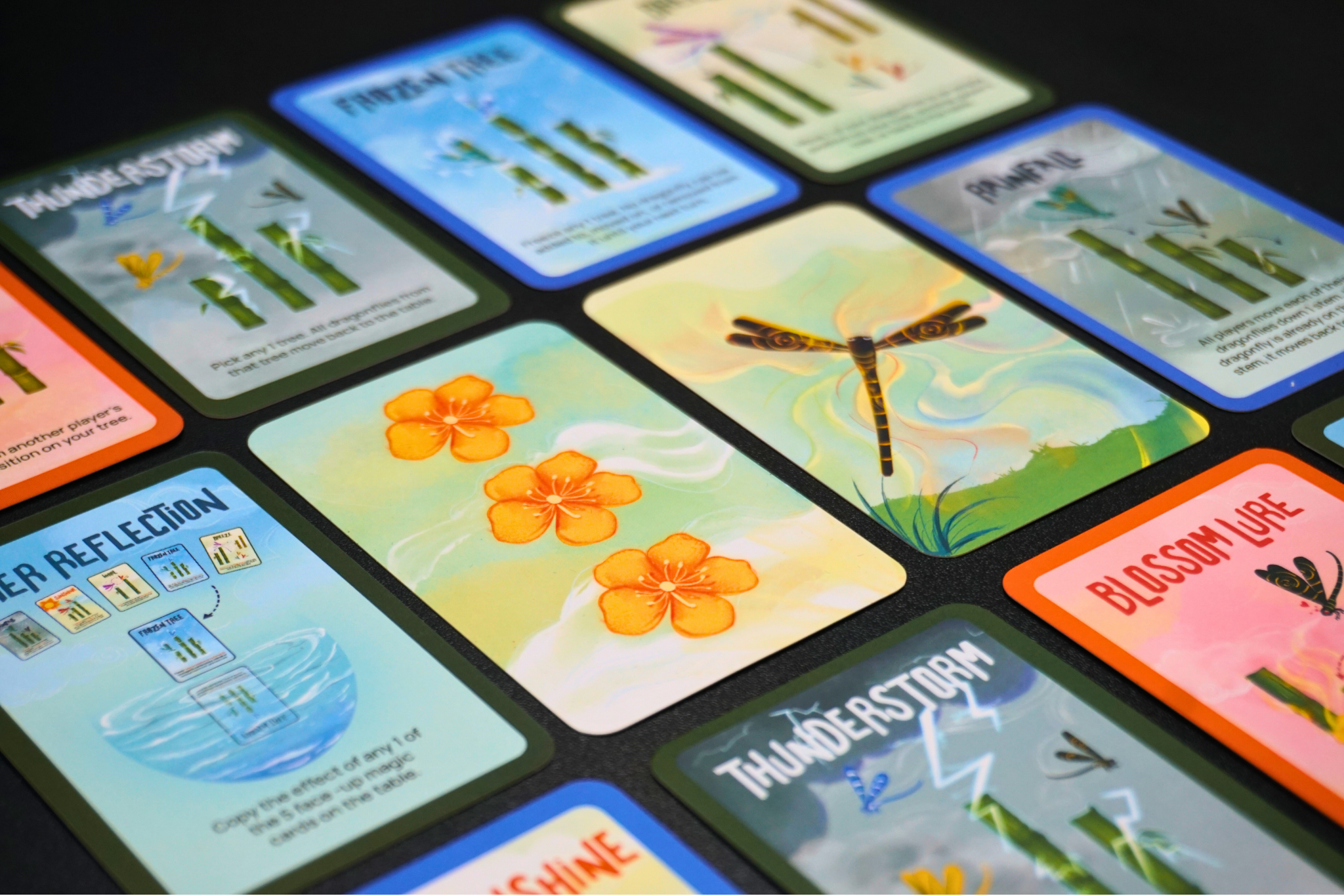
Chuồn Chuồn is a light strategy game where players catch colorful dragonfly pieces and arrange them on bamboo trees, trying to match the patterns shown on their objective cards. The patterns players need to match involve three things: color, size, and position. If you’ve never played before, you can watch our how-to-play video here:
Over the course of designing Chuon Chuon, we ran more than 85 playtest sessions. And there’s a moment that stayed with me ever since.
The Session That Changed Everything
We’d been running Chuồn Chuồn through family and casual groups for a while, and the feedback was mostly encouraging. The competitive mode leaned hard into sabotage and creating chaos around the table. There’s interaction, there’s attacking, there’s the fun chaos of messing with your friends. And I’ll be honest, I’m competitive by nature, so I enjoy this kind of gameplay a lot.
However, there was one session in particular that made it impossible to ignore.
I had two kids accompanied by their parents, full of energy, everyone having a great time. Then one of them played a Thunder Storm and knocked every dragonfly off the other kid’s tree. It was a perfectly strategic and legal move. But the other child didn’t see it that way. He was hurt, confused, then he cried because all of his previous dragonflies that he worked hard recruit were all gone.
Chuồn Chuồn is a game inspired by my childhood memories, and the last thing we ever wanted was for it to make a child feel attacked. That moment made me realize we hadn’t fully designed for the family experience. When parents sit down with young children, nobody really wants to crush an eight-year-old, and an eight-year-old who feels ganged up on isn’t going to ask to play again. We want this game to create great memories — not bring out the worst in people. So we built Co-op mode.
Building Co-op Mode
We wanted a mode where everyone at the table pulls in the same direction. The goal wasn’t to remove challenge, it was to redirect it away from each other and toward something shared.
Looking back at the co-op games we’d played and loved, two things kept coming up as essential. The first was true interdependence: not just “everyone contributes,” but a structure where the team wins or loses together, where helping your teammate isn’t optional but it’s the only path forward. In Co-op mode, you score points for the team, so you can’t just focus on your own objective. You have to help other players complete theirs too.
The second was a constant threat. Something actively working against you, a pressure that forces everyone to stay sharp and communicate throughout.
We built the mode around both of those ideas. The team plays across seven rounds and must reach a specific flower point total to win. No partial credit, no consolation levels. You either make it or you don’t.
Of course, that on its own could make the game feel too easy, so we needed to balance the cozy, relaxed feel with enough challenge for the whole family to enjoy. We introduced a few constraints. First, each player has only one bamboo tree, instead of two like in competitive mode. Second, starting from Round 2, the team must complete a minimum number of Objective cards each round. Miss the quota once — even by a single card — and the game ends immediately. The team loses.
Players leaned in. Discussions started filling the table. People anticipated each other’s moves, pointed out opportunities, flagged risks before they became problems. Every round carried real weight, and that weight made the collaboration feel meaningful rather than optional.
Making the game more enjoyable
We didn’t just add Co-op mode, we also rethought the core competitive gameplay to make it more enjoyable.
The first change was rebalancing the Magic card deck itself. We cut Sunshine and Rainfall from six copies each down to three, so their mirror effects don’t pile up across turns and bury players in setbacks. And we reworked Thunderstorm: instead of clearing an entire bamboo tree in one play, it now only removes the highest dragonfly on the chosen tree. Still a real threat, but the recovery for the opponent is manageable, while the card itself still remain powerful and strategic.
Together, these two changes shift the atmosphere without changing what the game fundamentally is. This gives players more breathing room between disruptions, without removing the competitive tension that makes the game engaging. Theses changes will be updated on the next version of Chuon Chuon when it is released later by our publishing partner.
We are really happy with how both of these changes have shaped up. The game still has teeth, but it has more heart too. A parent and their kids sitting down together, facing a challenge they have to solve as a team. That’s exactly the experience we were trying to build at Brainy Hearty.